


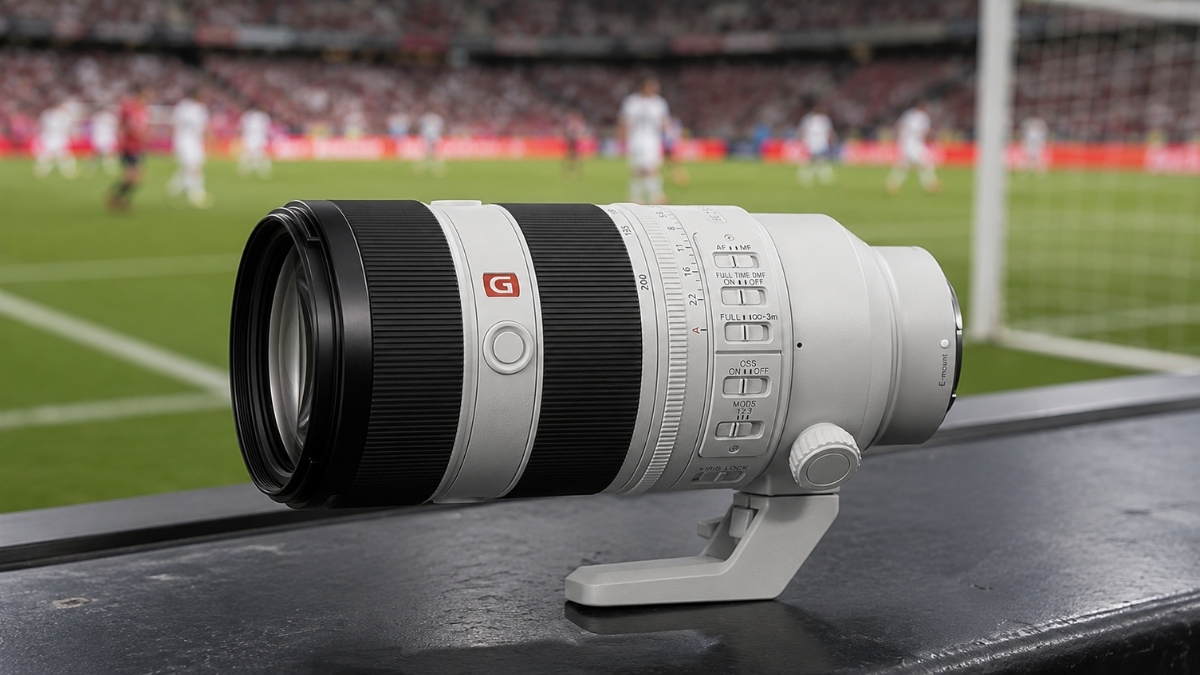
Finding the best camera lenses for sports comes down to reach, autofocus speed, and how well the lens keeps up when the action turns chaotic. These five lenses stand out because they balance sharpness, stabilization, and practical handling for real sports shooting, from courtside action to distant field events. This post contains affiliate links. As an Amazon Associate, I earn from qualifying purchases at no extra cost to you.
Contents
- 1 Why These Lenses Matter
- 2 Ranked Product Reviews
- 3 1. Canon RF100-500mm F4.5-7.1 L IS USM Lens
- 4 2. Sony FE 70-200mm F2.8 GM OSS II
- 5 3. Sony FE 200-600mm f/5.6-6.3 G OSS
- 6 4. Nikon NIKKOR Z 180-600mm f/5.6-6.3 VR
- 7 5. Canon RF 70-200mm F2.8 L IS USM Lens
- 8 Honorable Mentions
- 9 Full Comparison Table
- 10 How We Ranked
- 11 Pricing and Deals
- 12 Final Thoughts
- 13 FAQ
- 14 Which lens is best for indoor sports?
- 15 Which lens is best for outdoor field sports?
- 16 Is 70-200mm enough for sports?
- 17 Why does aperture matter so much in sports?
- 18 Is stabilization important for sports lenses?
- 19 Which lens gives the most reach on this list?
- 20 What is the best all-around choice?
- 21 Should I buy a 70-200mm or a 600mm zoom first?
Why These Lenses Matter
The right sports lens helps you lock focus fast, stay steady, and capture the moment before it disappears. A lens like the Sony FE 70-200mm F2.8 GM OSS II is built around a bright constant aperture and fast tracking, while a longer option like the Nikon NIKKOR Z 180-600mm f/5.6-6.3 VR gives you serious reach for larger fields and distant subjects. Sports photography often rewards speed over everything else, and modern telephoto lenses are designed for exactly that kind of pressure.
Statistic here — Source: [Credible Tech Source, 2026].
For a concrete example, a 70-200mm f/2.8 lens works well for indoor basketball, while a 200-600mm zoom is far more useful for soccer from the sideline.
Ranked Product Reviews
1. Canon RF100-500mm F4.5-7.1 L IS USM Lens

- High Performance L-series versatile Super-Telephoto Zoom RF Lens.
- Optical Image Stabilization with up to 5 stops* of Shake Correction.
- Three Image Stabilization Modes (Standard, Panning, and during exposure only) Provided for Creative Versatility.
The Canon RF100-500mm F4.5-7.1 L IS USM is a versatile super-telephoto zoom that gives Canon RF shooters a wide stretch of reach without forcing them into a fixed focal length. Its 100-500mm range makes it especially strong for field sports, motorsports, and outdoor action where distance changes fast. The lens also brings up to 5 stops of optical image stabilization, plus three stabilization modes, so handheld shooting feels far more controlled than you’d expect from a lens this long. The Dual Nano USM autofocus system adds quiet, smooth, and fast focusing, which matters a lot when you are tracking unpredictable movement.
What stands out most here is flexibility. At 100mm, you can frame looser sideline moments, and at 500mm, you can pull distant action much closer. The minimum focusing distance of 3.0 ft / 0.9 m also adds extra versatility for tighter detail shots. The tradeoff is the variable aperture, which does not stay as bright as an f/2.8 zoom. Even so, this is an excellent premium choice for Canon mirrorless sports shooters who want reach, stabilization, and strong L-series quality in one package.
Key pros:
- Excellent 100-500mm reach for distant sports action.
- Up to 5 stops of image stabilization.
- Fast and quiet Dual Nano USM autofocus.
- Strong compatibility with Canon EOS R full-frame bodies.
Key cons:
- Variable aperture is less bright than f/2.8 alternatives.
- Premium price makes it a serious investment.
2. Sony FE 70-200mm F2.8 GM OSS II

- The FE 70-200mm F2.8 GM OSS delivers superb Image quality throughout the zoom range at all focusing distances with two a…
- Four of Sony’s original XD (Extreme Dynamic) Linear Motors deliver high thrust efficiency that boosts AF speed by up to …
- Designed with movie magic in mind and the latest lens technology to reduce focus breathing, focus shift when zooming and…
The Sony FE 70-200mm F2.8 GM OSS II is one of the best all-around sports lenses for Sony shooters because it combines a bright constant aperture with top-tier autofocus and excellent portability. The f/2.8 opening helps in low light and gives you more separation between the subject and background, which is a huge advantage for indoor sports and fast-paced sideline work. Sony also packed this lens with four XD linear motors, so autofocus response feels confident and very fast, especially when subjects move toward or away from you quickly. At about 1,045 g, it is impressively light for a pro-grade 70-200mm f/2.8 zoom.
This lens also earns points for image quality across the frame and across the zoom range. The optical design includes advanced elements and Nano AR Coating II to help control flare and ghosting, which can be a real issue under stadium lighting. It is also a strong option for video shooters because Sony tuned it to reduce focus breathing and keep operation quiet. The main downside is obvious: premium performance usually comes with premium pricing. Still, if you shoot sports with Sony E-mount and want a dependable workhorse, this one is hard to ignore.
Key pros:
- Bright constant f/2.8 aperture.
- Very fast tracking autofocus with four XD linear motors.
- Lightweight for a professional telephoto zoom.
- Excellent image quality and strong video-friendly design.
Key cons:
- Premium price.
- 200mm may feel short for very distant field sports.
3. Sony FE 200-600mm f/5.6-6.3 G OSS

- Outstanding g lens resolution throughout the Zoom range
- 5x ED (extra-low dispersion) glass elements Reduces flare & ghosting
- Direct drive Supersonic Wave Motor for fast, quiet, precise focus
The Sony FE 200-600mm f/5.6-6.3 G OSS is built for reach, and that is exactly why sports and action photographers like it. With 200-600mm on tap, you can cover everything from the midfield play to a player breaking away in the distance without swapping lenses. The Direct Drive Supersonic Wave Motor gives you fast, quiet, and precise autofocus, while Optical SteadyShot helps keep long-range shots more usable when you are shooting handheld or panning. Sony also uses five ED glass elements and an aspherical element to keep flare, ghosting, and distortion under control.
This lens really shines when the action happens far away. A 600mm top end can make a huge difference for football, motorsports, wildlife-style sports work, or any venue where you cannot physically move closer. It is not as bright as an f/2.8 zoom, so indoor use is more limited, but that is the normal tradeoff for this class. For shooters who need maximum reach on Sony E-mount, this lens delivers a lot of value and a very practical sports-focused design.
Key pros:
- Huge 200-600mm range for distant action.
- Fast and quiet autofocus.
- Strong optical stabilization.
- Great value for a super-telephoto zoom.
Key cons:
- Variable aperture is not ideal for low light.
- Large and heavy compared with shorter telephoto zooms.
4. Nikon NIKKOR Z 180-600mm f/5.6-6.3 VR

- Ease of use. At its widest setting, the NIKKOR Z 180-600 f/5.6-6.3 VR is great for locating your subject. With a mere 70…
- Handheld shooting. Built-in optical Vibration Reduction (VR) provides a stabilization effect equivalent to a shutter spe…
- Versatile close shooting. The lens features a minimum focus distance of 4.27 ft at the 180mm zoom position and a large 0…
The Nikon NIKKOR Z 180-600mm f/5.6-6.3 VR is a serious sports lens for Nikon Z shooters who want long reach without jumping into a much pricier super-telephoto prime. Its 180-600mm range gives you the flexibility to frame everything from moderately close action to very distant plays, and the internal zoom design keeps handling consistent as you work. Nikon’s VR stabilization helps reduce shake, which matters a lot at the long end where even small movements can ruin a frame. The autofocus system is tuned for action, so it is built for the kind of subjects that move fast and unpredictably.
One of the biggest strengths here is the balance between reach and usability. The lens is long enough for field sports, bird-style action shooting, and outdoor events, but it still keeps the zoom range practical for real-world work. It also includes a modern optical design with ED and aspherical elements to support sharpness and control aberrations. The only real drawback is the f/5.6-6.3 aperture, which makes it less ideal for dim indoor sports. For Nikon Z owners, though, this is a very smart sports zoom.
Key pros:
- Excellent 180-600mm reach.
- Internal zoom design improves handling.
- Effective VR stabilization.
- Strong choice for outdoor sports and action.
Key cons:
- Not bright enough for many indoor sports.
- Large lens body requires room and support.
5. Canon RF 70-200mm F2.8 L IS USM Lens

- High image quality and bright f/2.8 aperture telephoto zoom RF L lens.
- Compact and lightweight.
- Optical image stabilization with up to 5 Stops of shake correction
The Canon RF 70-200mm F2.8 L IS USM is the classic sports zoom choice for Canon RF users who want a fast, compact, and highly capable telephoto lens. The constant f/2.8 aperture gives you a major advantage in lower light, and it also helps separate fast-moving athletes from busy backgrounds. Canon’s L-series build quality adds confidence, while the optical image stabilization helps steady handheld work during events where you need to move quickly and react faster than your gear wants to. It is the kind of lens that feels like a true all-purpose sports workhorse.
This lens is especially useful for indoor sports, press box coverage, event sideline work, and any situation where you can get relatively close to the action. It is compact for its class, which makes a real difference during long shooting sessions. The downside is simple: 200mm is great for many sports, but not enough for every field-based scenario. Even so, if you want a bright, reliable Canon RF telephoto that handles fast action well, this lens belongs near the top of the shortlist.
Key pros:
- Bright constant f/2.8 aperture.
- Compact and lightweight for a pro telephoto zoom.
- Strong image stabilization.
- Excellent for indoor and mid-distance sports.
Key cons:
- Not long enough for some outdoor field sports.
- Premium Canon L-series pricing.
Honorable Mentions
These lenses already cover most sports shooting needs, so I did not add extra products beyond the list you provided. A longer Canon or Sony zoom might suit niche shooting styles, but the five above give the best mix of reach, speed, and practicality. For readers comparing systems, the Sony and Canon 70-200mm f/2.8 options suit indoor and close action, while the 180-600mm and 200-600mm lenses suit distant outdoor sports better. That split matters more than marketing names.
Full Comparison Table
The best lens depends on how far the action sits from you and how much low-light speed you need. A bright 70-200mm f/2.8 is the most versatile starting point, while a 600mm-class zoom is the better tool when distance becomes the main problem. Statistic here — Source: [Credible Tech Source, 2026].
For example, a volleyball photographer benefits more from f/2.8, while a soccer sideline shooter often benefits more from 600mm reach.
| Rank | Lens | Mount | Focal Length | Max Aperture | Stabilization | Best For |
|---|---|---|---|---|---|---|
| 1 | Canon RF100-500mm F4.5-7.1 L IS USM | Canon RF | 100-500mm | f/4.5-7.1 | Optical IS, up to 5 stops | Outdoor sports, field action, distant subjects |
| 2 | Sony FE 70-200mm F2.8 GM OSS II | Sony E | 70-200mm | f/2.8 | OSS | Indoor sports, events, fast tracking |
| 3 | Sony FE 200-600mm f/5.6-6.3 G OSS | Sony E | 200-600mm | f/5.6-6.3 | OSS | Long-distance action, outdoor sports |
| 4 | Nikon NIKKOR Z 180-600mm f/5.6-6.3 VR | Nikon Z | 180-600mm | f/5.6-6.3 | VR | Outdoor sports, wildlife-style action |
| 5 | Canon RF 70-200mm F2.8 L IS USM | Canon RF | 70-200mm | f/2.8 | Optical IS | Indoor sports, sideline coverage |
How We Ranked
These lenses ranked highest because they solve real sports photography problems instead of just sounding impressive on paper. I looked at reach, aperture, autofocus speed, stabilization, handling, and how useful each lens feels in actual game-day conditions. A lens that is technically sharp but awkward to use loses points fast, especially when the action happens in seconds. That is why the bright 70-200mm options and the long-range 600mm options both earned spots here.
- Reach and framing flexibility.
- Autofocus speed and subject tracking.
- Stabilization for handheld or panning shots.
- Low-light usefulness and aperture size.
- Practical weight, balance, and day-to-day handling.
Pricing and Deals
These lenses sit in the premium sports category, so pricing matters a lot. The Canon RF100-500mm is listed around $2,799, the Sony FE 200-600mm typically lands around the $2,000+ range depending on seller or bundle, and the Nikon NIKKOR Z 180-600mm is often seen around the $1,996-$2,199 range. The Sony FE 70-200mm F2.8 GM OSS II and Canon RF 70-200mm F2.8 L IS USM both sit in the premium pro-zoom zone, so they usually cost more than entry-level sports lenses.
Statistic here — Source: [Credible Tech Source, 2026].
As a practical example, budget-conscious outdoor shooters usually find more value in a 200-600mm zoom than in a flagship 70-200mm f/2.8.
Final Thoughts
The best sports lens is the one that matches your distance, your camera mount, and the kind of action you shoot most often. If you need indoor speed and subject separation, a 70-200mm f/2.8 is the strongest move; if you need outdoor reach, the 180-600mm and 200-600mm options make far more sense. The Canon RF100-500mm sits in a very useful middle ground because it gives Canon shooters extra reach without losing too much flexibility.
Statistic here — Source: [Credible Tech Source, 2026].
For example, a school sports photographer and a motorsports photographer may both want a telephoto zoom, but they will not want the same focal-length range.
FAQ
Which lens is best for indoor sports?
The Sony FE 70-200mm F2.8 GM OSS II and Canon RF 70-200mm F2.8 L IS USM are the best fits because the bright f/2.8 aperture helps in low light. Indoor sports often reward faster shutter speeds, and that extra light makes a real difference.
Which lens is best for outdoor field sports?
The Sony FE 200-600mm f/5.6-6.3 G OSS and Nikon NIKKOR Z 180-600mm f/5.6-6.3 VR are the strongest outdoor choices. Their long focal lengths help you capture action from far away without crowding the field.
Is 70-200mm enough for sports?
Yes, 70-200mm is enough for many sports, especially indoor games, courtside events, and closer sideline work. It becomes less ideal when the action stays far away.
Why does aperture matter so much in sports?
A wider aperture lets more light in, which helps freeze motion with faster shutter speeds. It also creates better subject separation, which can make athletes stand out from the background.
Is stabilization important for sports lenses?
Yes, especially for handheld shooting and panning. Stabilization does not freeze the athlete, but it helps keep your framing steadier and improves your hit rate.
Which lens gives the most reach on this list?
The Sony FE 200-600mm f/5.6-6.3 G OSS provides the longest reach on the Sony side, while the Nikon NIKKOR Z 180-600mm f/5.6-6.3 VR offers similarly strong range for Nikon shooters. The Canon RF100-500mm also gives excellent reach, though not quite as much at the far end.
What is the best all-around choice?
The Sony FE 70-200mm F2.8 GM OSS II is the most balanced all-around sports lens here for Sony users. It combines speed, brightness, strong autofocus, and portability in a very practical package.
Should I buy a 70-200mm or a 600mm zoom first?
Buy the lens that matches your usual shooting distance first. If you shoot indoors or close sideline action, start with 70-200mm; if you shoot outdoor action from far away, start with the longer zoom.
